
Our contribution to climate protection: CO2-neutral airport operations
Hamburg Airport takes pioneering role in reduction of CO2 emissions
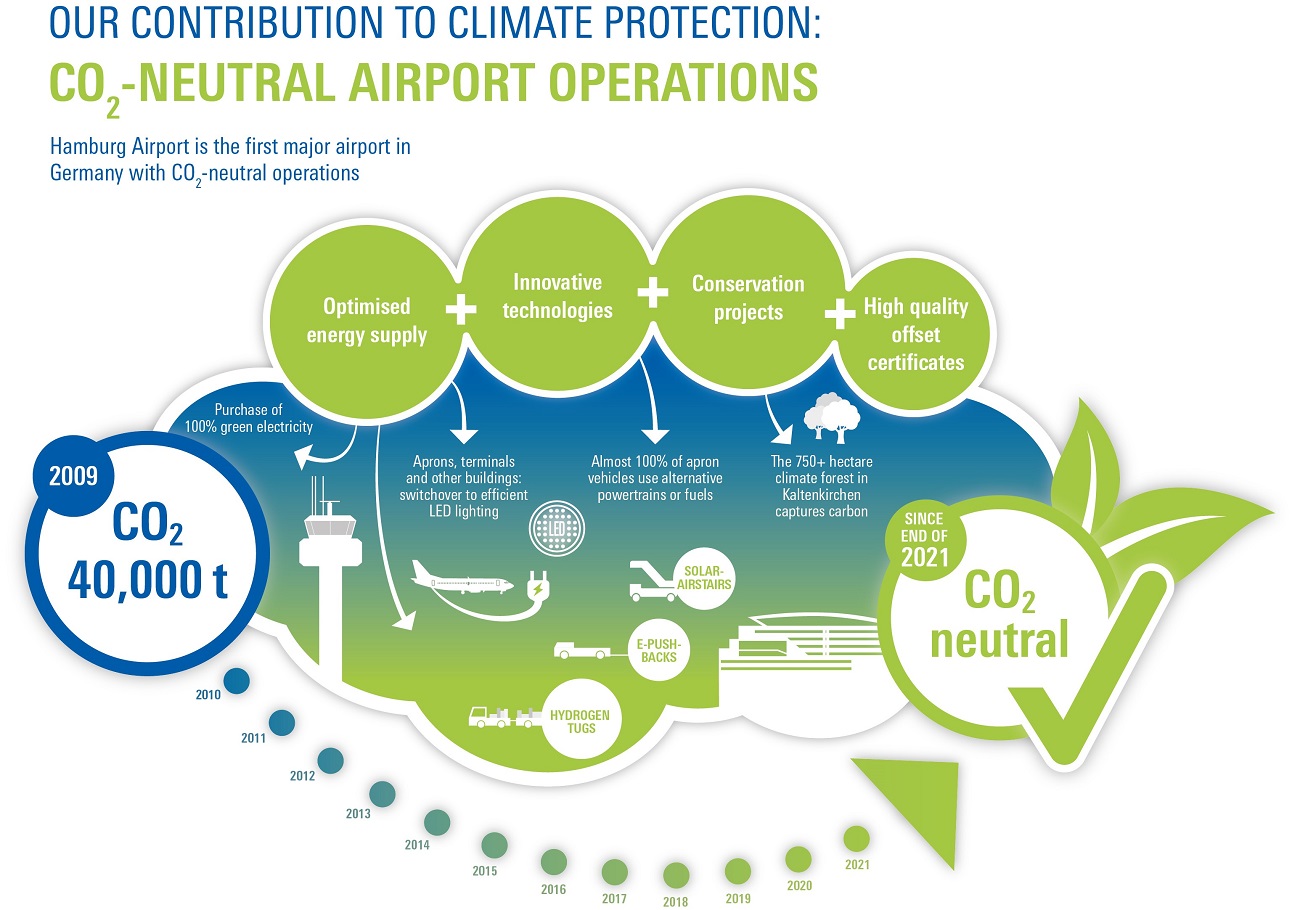
The building blocks of CO2-neutral airport operations are: reduced energy consumption, innovative technologies, conservation projects, and high quality offset certificates. At the end of 2021, Hamburg Airport became the first major commercial airport in Germany to achieve this goal of CO2-neutral operations.
Despite the economic difficulties arising from the coronavirus pandemic, Hamburg Airport is pursuing its climate protection goals as a top priority. The airport is benefiting today from the innovative environmental work that has already been undertaken over a more than three decades. This successful early environmental management has enabled Hamburg Airport to achieve the ambitious target of CO2 neutrality.
Hamburg Airport: CO2-neutral airport operations
Aviation is one of many determinant factors on the path towards a CO2-neutral, climate-friendly future. In 2018, global air traffic contributed 3.01 percent of worldwide greenhouse gas emissions (Aviation Climate Protection Portal). Hamburg Airport had made its aim the minimisation of the environmental impact of airport operations. For many years now, we have been adopting the latest technologies to save energy wherever possible.
Always one step ahead – for the sake of the environment
Environmental protection has been a focus of Hamburg Airport for decades already. As long ago as 1999, Hamburg Airport was the first airport anywhere in the world to achieve both EMAS and ISO 14.001 environmental management certification. As such, Hamburg Airport has long been at the vanguard of airport activities in the field of environmental protection. Since the end of 2021 Hamburg Airport has fully CO2-neutral operations, making it the first airport in Germany to achieve level 3+ certification with Airport Carbon Accreditation.
Less energy consumption and fewer CO2 emissions
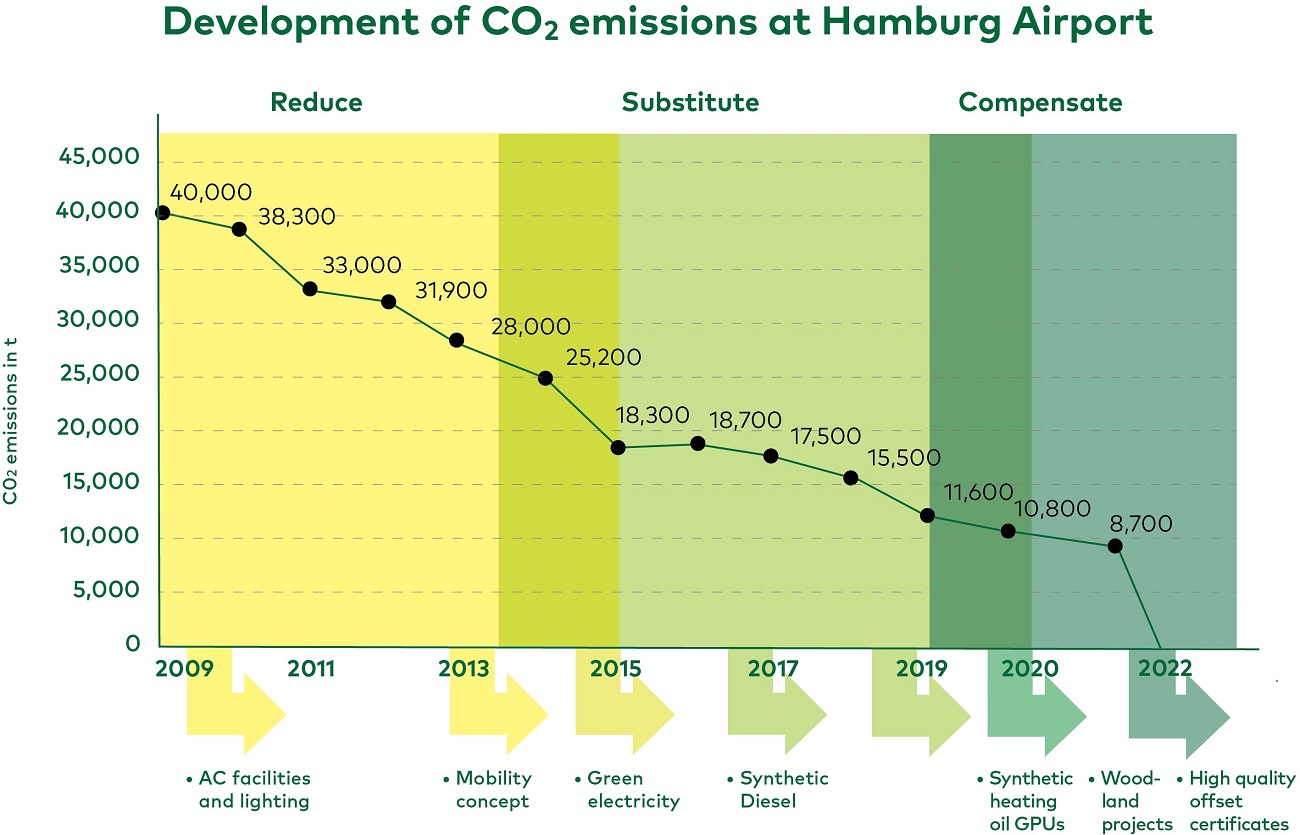
Hamburg Airport has reduced its annual CO2 emissions by 70 percent since 2009 as a result of its own efforts. Other measures such as the airport’s own forest project in combination with offset certificates enabled the airport operator to achieve a reduction of around 80 percent in its annual CO2 footprint, compared to 2009, by the end of 2021. In order to fully compensate for the remaining CO2 emissions, Hamburg Airport invests in high quality offset certificates. This is only a transitional measure until Hamburg Airport can eliminate or balance all CO2 emissions by its own actions.
Thinking globally: high quality offset certificates
Hamburg Airport supports numerous projects around the world that contribute to achieving verifiable reductions of CO₂ emissions within the global cycle. Our aim: by achieving further CO₂ reductions through our own actions, the proportion of offset certificates purchased will be reduced step by step. By 2035, we aim to reduce our CO₂ emissions to zero. Until this goal is achieved, we are offsetting emissions with certificates from these projects:
- Impact Carbon ICS, Uganda/Rwanda (Gold Standard):
This project distributes energy-efficient cookstoves that save up to 50% of fuel (wood/charcoal) and thus reduce approximately 750,000 tonnes of CO₂ annually. Families benefit from cost savings, improved air quality and local jobs in production and distribution. - Improved Kitchen Regimes PoA, Sub-Saharan Africa (Gold Standard):
By repairing boreholes, the need to boil contaminated water is eliminated – saving around 10,000 tonnes of CO₂ per year. Local training ensures long-term operation, reduces diseases and protects forests from overuse. - Mangrove Restoration, Myanmar (VCS 1764):
The reforestation of 2,100 hectares of mangroves sequesters approximately 184,000 tonnes of CO₂ annually through high biomass production and protects coastlines from erosion. Communities generate income through aquaculture, environmental training and infrastructure improvements. - Global Safe Water PoA, Kenya (Gold Standard):
Innovative filters replace firewood-based water boiling in schools, saving around 60,000 tonnes of CO₂ per year. Millions of students receive clean water, diseases are prevented and more time is available for education. - Luangwa Community Forests, Zambia (VCS REDD+):
Protection of 766,000 hectares of forest (expandable to 3 million ha) prevents deforestation and saves 700,000 tonnes of CO₂ annually. Alternative income sources combat poverty and secure water and health infrastructure as well as wildlife habitats. - Madre de Dios, Peru (VCS/CCBS REDD+):
Sustainable management of 100,000 hectares of rainforest prevents deforestation and reduces 660,000 tonnes of CO₂ annually. Local communities benefit from jobs, training and biodiversity conservation.
We switch over wherever we can – and will continue to do so
With every new facility, every project and every acquisition, Hamburg Airport has its sights firmly set on climate protection. By investing in state-of-the-art technology, regenerative energies and synergies, Hamburg Airport is securing its CO2-neutral operations for the future. Long-term, we are pursuing our goal of completely eliminating carbon dioxide emissions.